
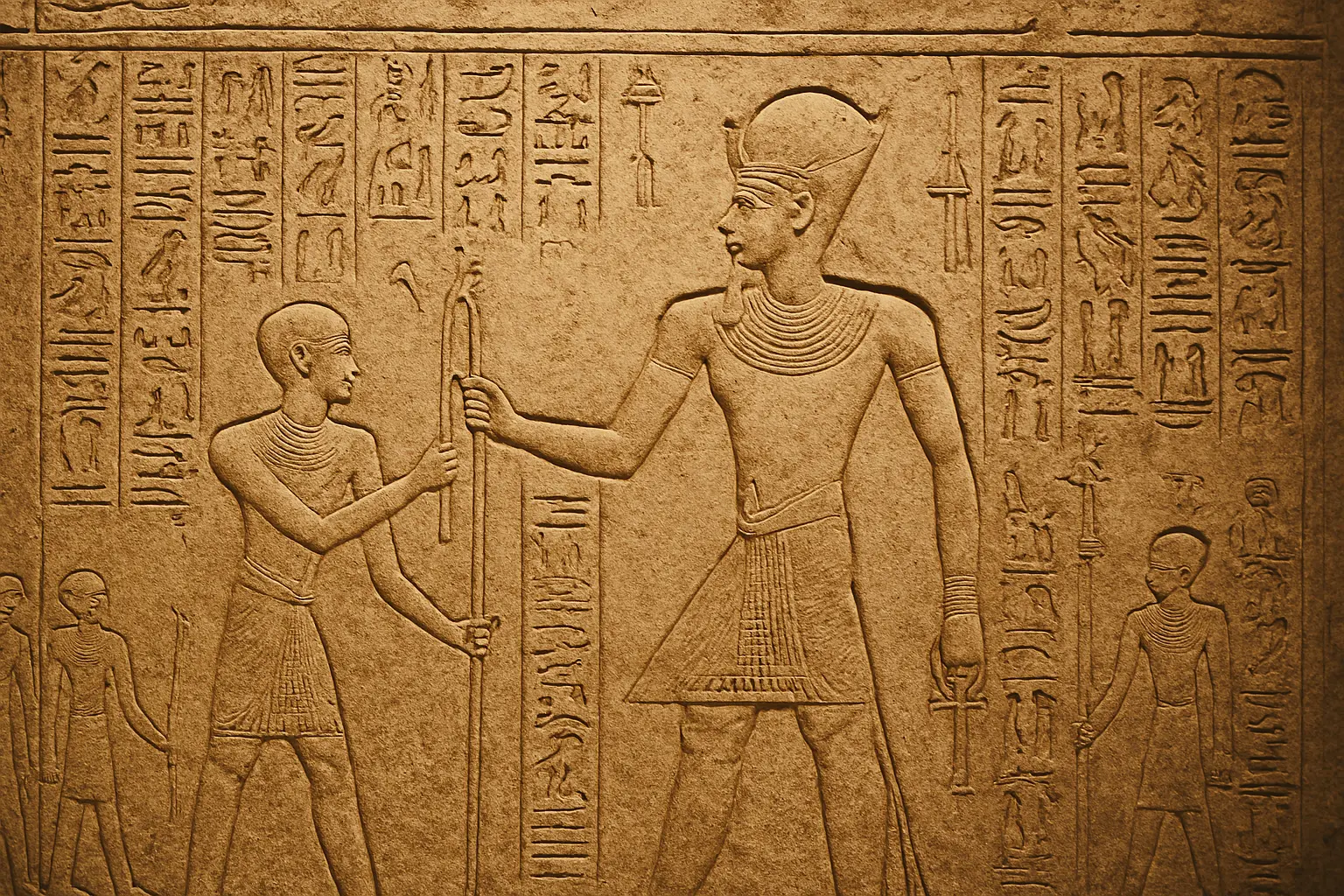
Many people question why Pharaoh ordered the killing of the firstborns. To understand this story, we must go back to the book of Exodus, chapter 1.
The book of Exodus shows how God dealt with the children of Israel. At that time, Joseph had already died, and the persecution of God’s people by the Egyptians lasted approximately 200 years.
This Pharaoh, who did not know Joseph, was probably Thutmose I. Counting the total time the Israelites spent in Egypt, it adds up to 430 years. The people of Israel lived these 430 years in Egypt under a heavy and unequal yoke.
God’s people left the land of Egypt exactly on the day the 430 years were completed. But we will talk about the liberation in another study.
Pharaoh’s Fear and the Plan Against the Israelites
Pharaoh ordered the killing of all the firstborns because he observed that the Hebrew people were more numerous and stronger than his own people. He then developed a plan to prevent the Israelites from becoming even more numerous.
The Word of God relates that Pharaoh believed that if he did nothing to stop this growth of the people of Israel, there could be war. In that case, Israel would join the enemies, fight against them, and then flee from the land of the Egyptians.
“Look,” he said to his people, “the Israelites have become far too numerous for us. Come, we must deal shrewdly with them or they will become even more numerous and, if war breaks out, will join our enemies, fight against us and leave the country.” (Exodus 1:9-10, NIV)
The Egyptians appointed taskmasters to oversee the people’s work. Now under oppression, the Israelites built two cities that served as storage centers for Pharaoh: Pithom and Rameses.
Pharaoh’s plan was not working. The more God’s people were oppressed, the more they multiplied and spread. This made the Egyptians even more worried. As a result, they forced the Israelites to work cruelly.
So they put slave masters over them to oppress them with forced labor, and they built Pithom and Rameses as store cities for Pharaoh. But the more they were oppressed, the more they multiplied and spread; so the Egyptians came to dread the Israelites and worked them ruthlessly. (Exodus 1:11-13, NIV)
Not content with this situation in which the people of Israel found themselves, Pharaoh, king of Egypt, ordered the Hebrew midwives Shiphrah and Puah to kill the baby boys when assisting the Hebrew women in childbirth, but to let the girls live.
Pharaoh did not count on the fact that the midwives feared God. They refused to obey the king’s order and let the boys live.
“When you are helping the Hebrew women during childbirth on the delivery stool, if you see that the baby is a boy, kill him; but if it is a girl, let her live.” The midwives, however, feared God and did not do what the king of Egypt had told them to do; they let the boys live. (Exodus 1:16-17, NIV)
God was kind to the midwives, honoring them. Thus, the Israelites continued to multiply and became even stronger.
Pharaoh gave a new order to all his people: to throw all newborn Hebrew boys into the Nile River. This order applied only to male boys; the girls could live.
Then Pharaoh gave this order to all his people: “Every Hebrew boy that is born you must throw into the Nile, but let every girl live.” (Exodus 1:22, NIV)
The Birth of Moses Amid Pharaoh’s Persecution
In the midst of this turmoil that the people of Israel were experiencing, a man and a woman from the tribe of Levi married. This woman became pregnant and gave birth to a boy, who would later become the liberator of God’s people.
That baby was beautiful, and his mother hid him for three months. When it was no longer possible to hide him, she took a basket made of papyrus reeds and coated it with tar and pitch.
That mother, with no choices left, placed the baby in the basket and put it among the reeds on the bank of the Nile River.
The baby had a sister who watched from a distance to see what would happen to him along the river’s course. In that same river, Pharaoh’s daughter went down to bathe, while her servants walked along the riverbank.
Pharaoh’s daughter saw the basket among the reeds and sent her servant to get it. When she opened it, she saw the baby crying and felt sorry for him. She thought he might be one of the Hebrew boys and he really was.
The boy’s sister, with great courage, approached and asked the princess if she wanted her to call a Hebrew woman to nurse the baby.
After the princess agreed, the girl who was actually the baby’s sister went and called his mother. Pharaoh’s daughter made an agreement with the mother: to take the boy and nurse him, receiving wages for it.
When the boy grew up, the mother took him back to Pharaoh’s daughter, who adopted him as her own son. She named him Moses, saying that she had drawn him out of the water.
Pharaoh’s daughter said to her, “Take this baby and nurse him for me, and I will pay you.” So the woman took the baby and nursed him. When the child grew older, she took him to Pharaoh’s daughter and he became her son. She named him Moses, saying, “I drew him out of the water.” (Exodus 2:9-10, NIV)
